Moss Soft-Wash on a Glanmire Semi: Before/After Job Log
The call started as a suspected roof leak on a tree-covered Glanmire semi-D: a damp stain spreading along the fascia after every heavy shower. The leak was leaves. While we were up clearing the gutters we photographed a moss mat thick enough to hold water against the tiles for days, and the homeowner booked the soft-wash on the spot. Treatment from €350, gutter clear on top, before and after photos below.
Key Takeaways
- Roof soft-wash on a typical Cork semi starts at €350 (job log, 2026 Cork rates).
- Pressure washing is the wrong tool: it strips the tile surface and forces water under the laps.
- Moss holds water against tiles and feeds the gutters. Most Glanmire "roof leaks" we attend are overflowing gutters.
- Gutter clear and downpipe flush runs €180-€500 and is usually paired with the wash.
- Inland moss is a tree-cover problem. Coastal roofs run on a salt schedule instead.
The Glanmire callout where the "roof leak" was leaves
Glanmire's north-east suburbs sit under large trees, and the older stock toward Riverstown wears the proof of it. Last autumn we got the call this job log starts with: a semi-D with overflow staining the fascia, damp tracking down the wall, and a homeowner fairly certain the roof was leaking. It was not a roof leak. The gutters were packed solid with leaf litter and moss grit, the downpipe was blocked at the first bend, and every shower was sending the overflow straight down the fascia.
The fix that day was unglamorous: gutter clear, downpipe flush, photo report. The "roof leak" was leaves. But the ladder work gave us a close look at the roof itself, and the rear elevation told the real story. A moss mat across the north-facing slope, thickest along the laps and around the tile nibs, holding water like a sponge days after the rain had stopped. We photographed it, showed the homeowner on the phone screen, and quoted the soft-wash as a follow-up. She booked it for the following dry week.
That sequence is typical for Glanmire. The gutters announce themselves first because the overflow stains the fascia where you can see it from the garden. The moss that caused the blockage stays quiet on the roof for years.
Why is moss a problem on a tree-covered roof?
Moss is not just cosmetic. A heavy mat does three kinds of damage, and none of them announce themselves until the repair bill does.
- It holds water against the tile surface. Concrete tiles are designed to shed water, not sit in it. A moss mat keeps the roof wet for days after the rain stops, which shortens the tile's working surface and keeps the battens underneath damp.
- It makes frost damage worse. A saturated moss mat freezes in a cold snap, and that freeze-thaw action works on the tile face all winter. Inland Cork gets more frost nights than the coast, so Glanmire roofs feel this harder than Cobh or Kinsale.
- It feeds the gutters. Every shower washes moss grit and fragments down the laps into the gutter. Add Glanmire's autumn leaf load and you get the blocked downpipe that started this job log.
The pattern we see on tree-covered estates is always the same: moss builds for years, gutters block, fascia stains, and the first the homeowner knows about it is a damp patch they assume is a leak.
Why is pressure washing the wrong tool for roof moss?
Every autumn we get asked to price against a man with a pressure washer, and every autumn we give the same answer: do not let anyone pressure wash a tiled roof. It is the wrong tool for the job for three reasons.
First, it strips the tile. A concrete tile's weathered surface is its protection. A pressure washer blasts that face off, and the bare tile underneath weathers faster from that day on. The roof looks clean for a month and then ages quicker than the mossy one next door. Second, it drives water where water should never go. Held at the wrong angle, a pressure jet forces water up under the laps and into the felt, the exact leak path the homeowner was trying to avoid. Third, it leaves the root. Pressure washing shears the visible growth off and leaves the spores sitting in every lap and crevice, so the moss returns thicker within a couple of seasons.
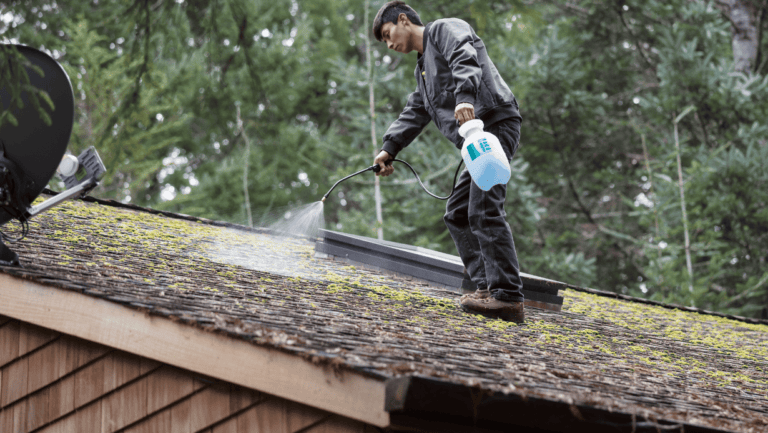
Soft-washing works the opposite way. We scrape the bulk growth off by hand, then apply a biocide at low pressure that soaks into the laps and kills the moss at the root. The dead growth weathers off over the following weeks and the biocide keeps working after we leave, killing spores as they land. Slower to look at, kinder to the tile, and it lasts.
What did the Glanmire soft-wash job log look like?
Tuesday, mid-October, dry forecast. A 1990s semi-D on a tree-lined Glanmire road, mature trees overhanging the back garden, moss mat heaviest on the north-facing rear slope. Names omitted with the homeowner's permission; everything else is from the job sheet.
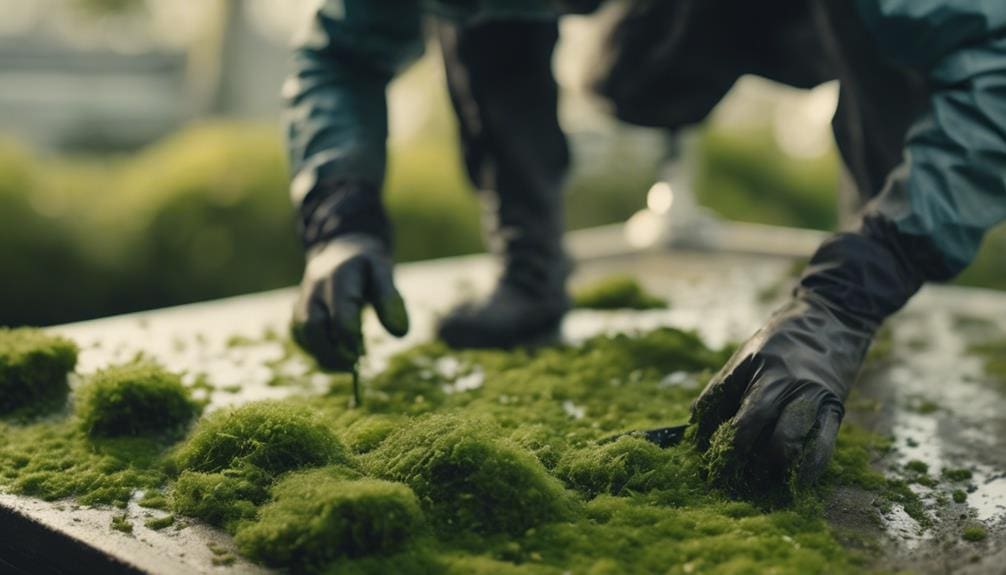
Ladder access to the rear, harness anchored off the ridge, no scaffold needed on this pitch. First pass was the bulk scrape: roof scrapers and stiff brushes, working from the ridge down so nothing got pushed up under the laps. Every bag of moss came off the roof with us. Scraping into the gutters just moves the blockage, so the gutters were sheeted before we started.
With the bulk growth off, David applied the biocide soft-wash at low pressure, ridge to eaves, with a second pass along the laps where the mat had been thickest. Then the gutter clear and downpipe flush that the original callout had started: the gutters were half-full again from the scrape sheeting and the season's leaf fall, so both runs were cleared to the gullies and the downpipes flushed until they ran clean. Job done in the day. Before and after photos went to the homeowner with the invoice that evening, along with the guarantee certificate.
The after photos show the tile face back to bare concrete with the dead moss releasing over the following weeks. That staged release is normal and we tell every customer to expect it: the roof keeps improving for a month after we leave.
What does moss removal cost in Cork in 2026?
Job log, 2026 Cork rates: a full soft-wash treatment on a typical semi-D starts at €350 including VAT. The paired gutter clear and downpipe flush runs €180-€500 depending on how full the runs are and how the downpipes drop. Scaffolding is the only wildcard: this Glanmire job went from a ladder, but a three-storey or a fragile roof adds €280-€650 before anyone starts scraping. If you want the before condition documented from the air first, a drone inspection is €100 fixed.
| Work item | Cork price (2026, inc. VAT) | Time on roof |
|---|---|---|
| Roof soft-wash clean (this article's job) | from €350 | Half to full day |
| Gutter clear + downpipe flush (paired job) | €180-€500 | 2-4 hours |
| Scaffolding (only if ladder access fails) | +€280-€650 | Added on top |
Two things keep the price at the low end: ladder access and getting it done before the moss mats hard enough to need a second treatment pass. This Glanmire job hit both. For the full service description, see our Cork roof cleaning and soft-wash page.
Why the gutter clear is the half of the job people skip
Cleaning the roof and leaving the gutters full is washing your car and leaving the handbrake on. Everything the scrape and the weather loosen off the tiles ends up in the gutter runs, and Glanmire's autumn leaf load joins it within weeks. Every soft-wash we do under tree cover is paired with a gutter clear and a downpipe flush, finished with a photo report so you can see the runs are empty without climbing a ladder yourself. The standalone version of that service sits on our Cork gutter cleaning page.
The photo report matters more than people expect. This homeowner had been quoted for a "roof leak repair" by somebody who never left the ground. The photos of a blocked downpipe and an empty, flushed gutter run closed that conversation for good.
What the homeowner said when the photos arrived: "I was braced for a leak repair and it was leaves all along." Total time on site across both visits: one morning for the gutters, one day for the soft-wash. Total disruption: none.
Moss building up in Glanmire? Send a photo, get a fixed price in 24h.
Free written quote inside 24 hours, no call-out fee. Michael personally reviews every quote before it goes out. 20-year written workmanship guarantee on jobs over €100.
How often should a Glanmire roof be cleaned?
Inland, the trees decide, not the calendar. A Glanmire semi under mature cover wants its gutters checked every autumn and the roof soft-washed when the moss starts matting, which might be every few years or might be longer on an open exposure. The coast runs the opposite logic: salt and wind-driven rain set the schedule there, and our coastal Cork salt-erosion schedule has soft-wash on a fixed 4-5 year cycle for the harbour towns because the exposure demands it. Glanmire's version of that pressure is leaf load and shade, so the trigger is what you see, not a fixed timer.
If you cannot see the roof from the ground, the autumn gutter clear doubles as the inspection: full runs of moss grit mean the mat above is building. That is the cheap early warning, and it is exactly how this job log started. For the wider service rhythm across the year, our roof maintenance programme for Cork homes sets out what gets checked and when.
And when moss has already let water sit long enough to slip a tile or stain a ceiling, the repair side of that story is the same one we see across the city. Our Douglas €150 repair job log shows what a small fix costs when it is caught early, and why catching it early is the whole game.
Frequently asked questions
Roof moss removal FAQs
How much does roof moss removal cost in Cork?
A full soft-wash treatment on a typical Cork semi-D starts at €350 including VAT (job log, 2026 Cork rates). That covers the bulk scrape, the biocide soft-wash application and the tidy-up. Pairing it with a gutter clear and downpipe flush runs €180-€500 depending on how full the gutters are. Heavy moss under mature trees, like most of Glanmire, sits toward the top of those bands.
Why can’t I pressure wash the moss off my roof?
Pressure washing is the wrong tool for roof moss. A pressure washer strips the weathered surface off concrete tiles, blasts water up under the laps and into the felt, and can crack older tiles outright. The roof looks clean for a month and then weathers twice as fast because the protective surface is gone. Soft-washing kills the moss at the root with a biocide and lets it release naturally over the following weeks.
Does roof moss actually cause leaks?
Moss itself rarely causes a leak directly, but it creates the conditions for one. A heavy moss mat holds rainwater against the tile surface like a sponge, keeps the roof wet for days after the rain stops, and feeds grit and leaf litter into the gutters until they overflow. Most of the roof leaks we get called to in tree-covered parts of Glanmire turn out to be overflowing gutters, and the moss is the reason they are full.
How long does a soft-wash treatment last?
The biocide keeps working after we leave, killing spores as they land, so regrowth takes years rather than months. Under heavy tree cover like the north-east Glanmire suburbs we recommend pairing the treatment with an autumn gutter clear so the roof and gutters stay dry between visits. On the coast we schedule soft-wash on a fixed cycle as part of the salt-erosion programme; inland, tree cover is the deciding factor instead.
Do I get a guarantee on a soft-wash job?
Every Roofers Cork City job over €100 carries a 20-year written workmanship guarantee, issued as a PDF certificate after the job and transferable with the property if you sell. Sub-€100 work carries a 12-month guarantee. The guarantee covers our workmanship; the biocide’s residual action is a product property rather than a workmanship item, and we explain that distinction on every quote.